R&D
CUSTOM DEVELOPMENTS & SPECIAL MANUFACTURING
When off-the-shelf solutions aren't enough, we develop. Backed by our in-house R&D laboratory and our international partner network, we formulate custom products tailored to the specific requirements of each client and each well.
From initial lab evaluation through plant production and field implementation, we support the entire process — delivering a solution that genuinely solves the problem.
TECNOLOGY
Solid Microencapsulated Chemicals
Microencapsulation is a technology that enables a liquid active substance to be incorporated into a solid particle matrix, resulting in a new product with superior characteristics compared to each precursor individually.
Unlike a simple mixture, the process creates intimate, specific contact between the active ingredient and the solid carrier at the individual particle level. The result is a solid microencapsulated active that combines the best of both technologies: the efficacy of the liquid active with the stability, handling, and dosage advantages of the solid support.
Why microencapsulate?
Encapsulation protects active substances from external agents — temperature, light, oxygen, moisture, and pH variations — creating a barrier effect that prevents deterioration and preserves integrity until the moment of release. This translates into more stable products, extended shelf life, and controlled, selective release under predefined conditions.
Custom Development
The versatility of the technique allows us to select and develop solid carriers with structural and functional characteristics tailored to each specific application. At MicroMoles, we evaluate the required particle size and structure, and the absorption/desorption capacity needed for each case — ensuring a product designed for the real conditions of the well.
Productive process
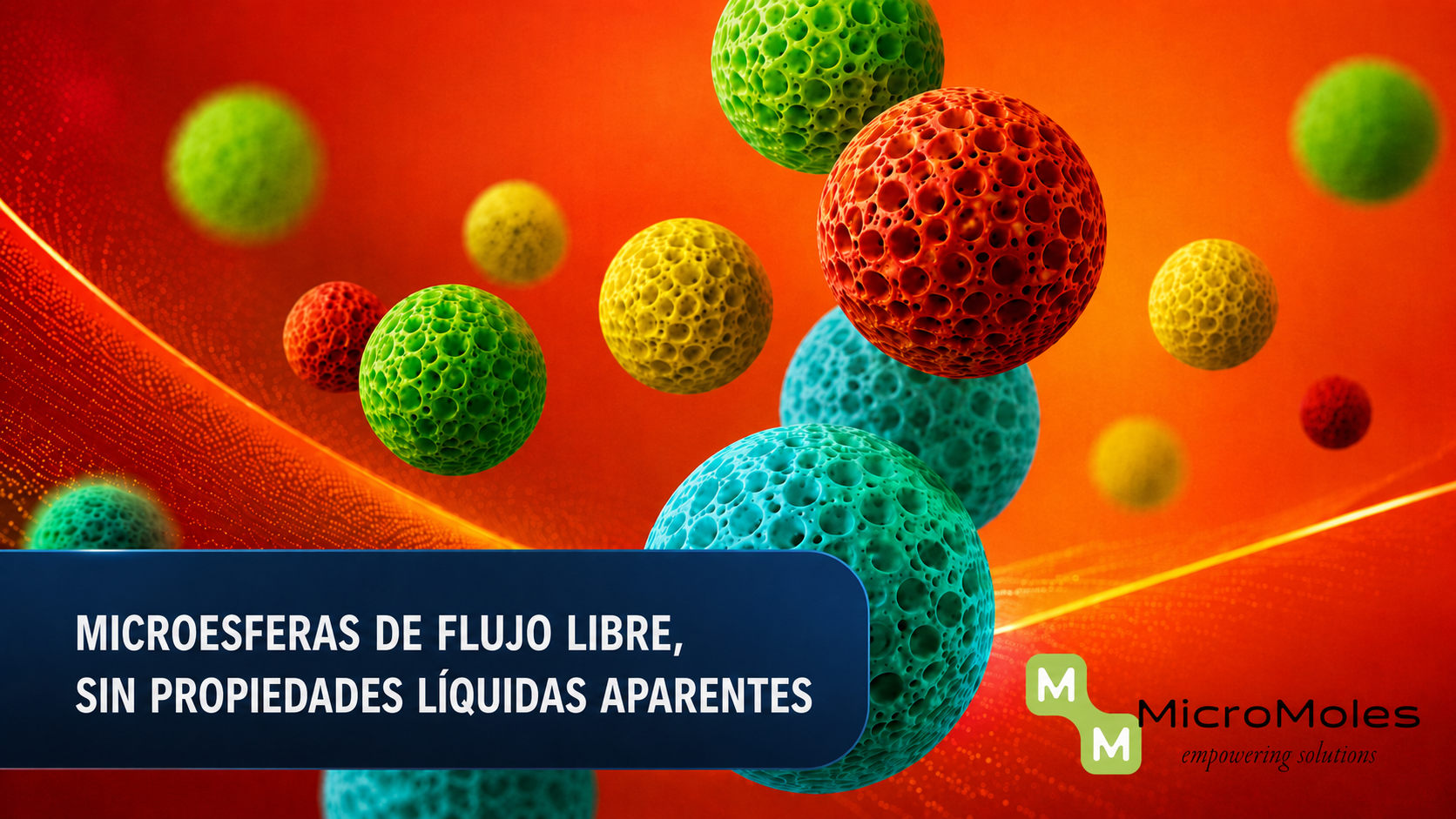
Microencapsulation at MicroMoles is performed through the controlled injection of the liquid active solution onto the solid matrix (carrier). The process is far more than a simple mix: every variable is rigorously controlled — injection time and pressure, temperature, flow rate, injector design — to maximize contact surface area and ensure each solid particle captures the active individually. The result is a solid, dry-flowing product with homogeneous distribution of the active ingredient — ready for direct dosage in the field.
ADVANTAGES OF THE MICROENCAPSULATION PROCESS
• Zero waste: The process generates no production waste, making it a cleaner and more sustainable alternative.
• Maximum active loading: Produces encapsulated materials with the highest possible concentration of liquid active ingredient, optimizing end-product efficiency.
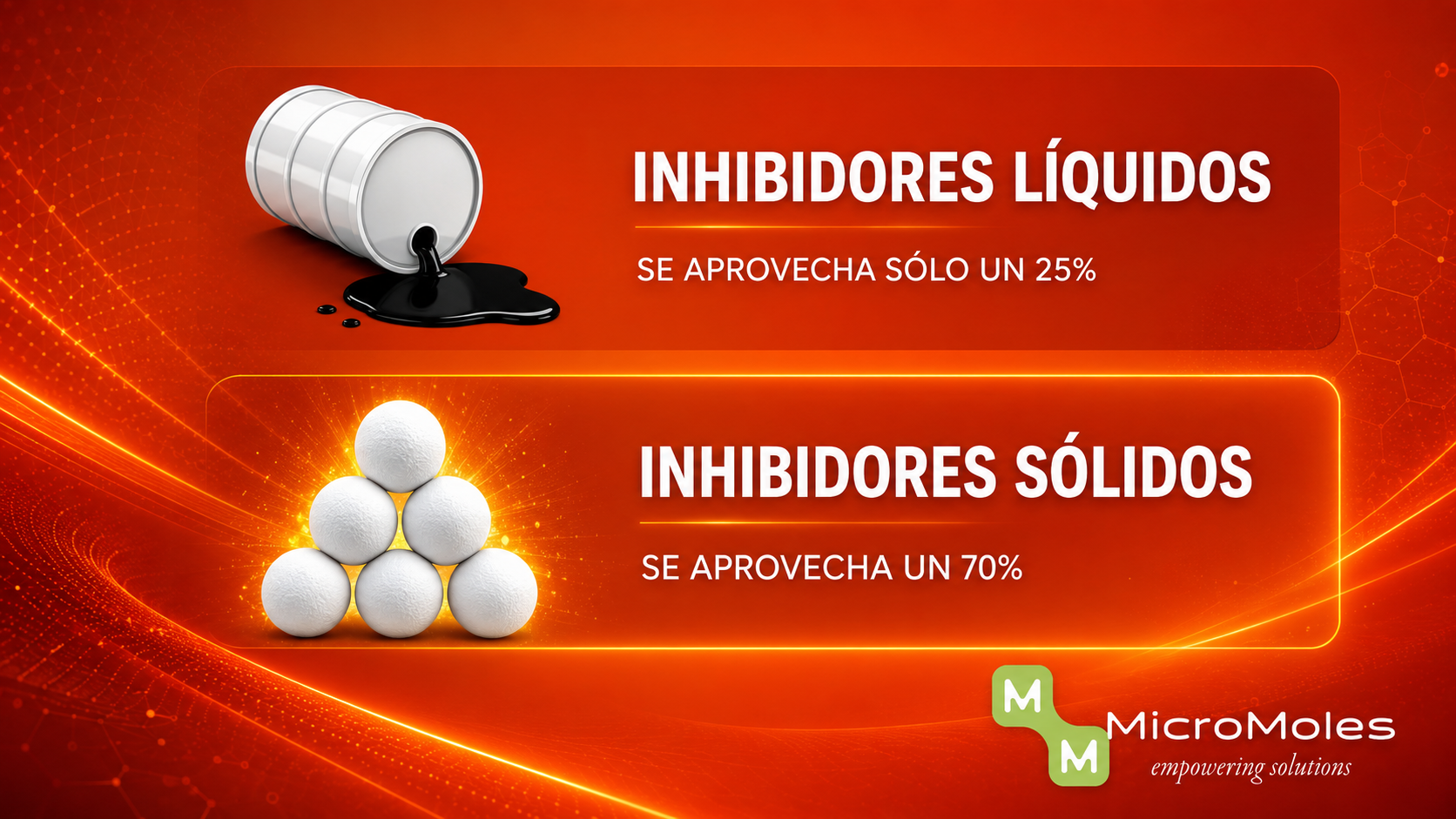
• High encapsulation rate: We achieve up to 70% microencapsulation of the active in the carrier matrix, while maintaining the dry, free-flowing appearance of the solid. New carrier development can increase this fraction further.
• Homogeneous distribution: The process maximizes uniformity of the microencapsulated active, minimizing particle agglomeration and unactivated carrier residue.
• Controlled release in the field: The capsule protects the active during transport and storage, releasing it selectively under the specific conditions of the well — temperature, pressure, or pH.
• Extended shelf life: The encapsulation barrier protects the active ingredient from degradation, significantly extending product stability.
• Easy handling and dosage: Solid, dry, free-flowing format simplifies logistics, storage, and direct field application without additional equipment.
• Custom development: Carrier selection and process parameters can be adjusted for each specific application, client, and operational condition.
BACKGROUND
Since some time, microencapsulation technology has been used to prevent the degradation of biological and physicochemical properties of those substances that are part of more complex matrices and are exposed to conditions that are harmful to them. In addition to this this method presents other applications of great interest in various sectors. Microencapsulation is defined as a technique for packaging solid, liquid or gaseous materials through the application of a thin cover called wall, on particles of the micron size. In this way microcapsules are obtained which consist of a semipermeable, strong and thin membrane of a polymeric material that surrounds and contains the substance of interest, called the active core or nucleus. These microcapsules can release their content at controlled rates under specific conditions while protecting the encapsulated compound from light and oxygen, thereby fulfilling its function of conserving biological or physicochemical properties. The substances that can be microencapsulated are vitamins, minerals, dyes, prebiotics, probiotics, flavorings, antioxidants, essential oils, enzymes, drugs and even fertilizers.
The microencapsulation technique has different purposes that depend mainly on the type of product to which it is applied and on the substance or active principle that is microencapsulated. The main applications allow to fulfill some of the following objectives:
Decrease the volatility or evaporation rate of the microencapsulated substance towards the external environment.
Provoke or allow the controlled and gradual release of the coated substance, under specific conditions of humidity, pH, system tension, action of enzymes, etc.
Reduce the exposure of the central material to external factors, mainly in those substances sensitive to heat, light or humidity and in the case of highly reactive compounds that tend to oxidize easily in the presence of oxygen.
Facilitate the handling of the substance that is microencapsulated, since this technique can convert a liquid material to a solid state. In addition, aggregation is prevented and mixing processes ensure that the substance of interest is uniform in the mixture.
Development of Solid Microencapsulated Chemicals
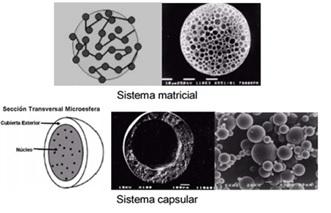
One of the concerns of the chemical industry is to develop safer products for the worker and the environment. In this sense, the introduction of microencapsulation processes allows to modify some of the physical-chemical properties of chemical products through the formation of two structures, the reservoir or capsular reservoir or capsular systems and the matrix systems. In the first case, the active principle is included in a kind of reservoir, which can be liquid to solid in nature, which has been wrapped by a thin film of the coating material. In the second case, the active principle is dispersed in the polymeric matrix. In the figure that follows, we can see the photographs obtained by scanning electron microscopy (SEM) of the structures of the two types of systems explained. Matrix system Capsular system:
The encapsulation is carried out in the form of molecules, solid particles or liquid globules, to give rise to particles of micrometric size. In this way, the product resulting from this technological process receives the denomination of "microparticles" (capsular system), "microcapsules" (matrix system) or "microspheres" (indistinctly, they only differ by their spherical shape), systems that differ in its morphology and internal structure, although all of them have as a common characteristic their particle size, which is always less than 1mm. When the particles have a size smaller than 1 μm, the product resulting from the microencapsulation process is called "nano spheres", "nanoparticles" or "nano-capsules"
The process of microencapsulation. The microencapsulation process must be designed taking into account a large number of factors that involve both the active component, the microencapsulated structure formed and its application. The variety of materials that can be used in microencapsulation is gradually expanded as new materials arise.
Determination of the release mechanism of the active principle
The selection of a matrix or membrane is important; the chemical nature, morphology and transition temperature, the degree of swelling and cross-linking also influence the diffusion of the membrane, which may affect the rate of release. All this contributes to establish the breaking of the bonds with the host molecule:
1- Diffusion through the wall of the capsule or a membrane that covers the wall. The permeability through the matrix and the solubility of the component of the capsule wall influence the diffusion rate. The compound to be diffused must be soluble in the matrix, although the vapor pressure of volatile substances on each side of the matrix can be the force that determines diffusion.
2- destruction of the microcapsule wall, or by physical processes (for a normal solution in water, by shear forces), or by chemical reactions (pH changes, or osmotic pressure, hydrolysis, thermal or enzymatic degradation). Biologically active substances, microencapsulated, containing a polymer in the form of a comb, soluble in water or dispersible in water.
Selection of encapsulating agents
The type of encapsulating agent employed will have an influence on the stability of the emulsion before drying, on the particle size, the properties and on the shelf life of the dehydrated encapsulated material. Some alternatives used are:
1- Inorganic materials such as silicates. Sodium silicate has proven to be a powerful encapsulant of hazardous materials, in bioremediation processes, turning soluble products into insoluble, volatile into non-volatile. Likewise, the organic compounds will be covered by silicate, reducing their potential risk of contamination. The properly encapsulated active components change their physical-chemical properties, making them resistant to the action of wind, rain and acid attacks
2- Lipids such as waxes, paraffins, oils or fats. They are used primarily for the formation of liposomes. Some of the most effective are hydrogenated oils such as palm oil, cotton and soybeans, which are excellent film formers capable of covering individual particles, providing uniform encapsulation.
3- Proteins such as gluten, casein, albumin, soy, caseinates and gelatin, the latter being one of the most used proteins. These encapsulating agents possess high emulsifying capacity, generating microcapsules of size less than 2 micrometers, but their solubility in water at low temperature, the potential to react with carbonyls and their high cost limit their use.
4- Gums such as sodium alginate Gums sodium alginate sodium alginate. They are hydrocolloids extracted from algae. Due to their characteristics of viscosity, solubility and emulsifying capacity, they are preferably used as components of the membrane that react with ions to induce the formation of stable gels. They are not suitable for retaining non-lipid molecules of low molecular weight. Gum arabic has traditionally been used as an encapsulating agent, but its shortage has led to the development of alternative gums such as agar-agar.
5- Polymers continue to be used as encapsulating agents because of their low cost, easy acquisition, susceptibility to innumerable chemical modifications and potentially degradable. This group includes polymers of natural origin, mere of natural origin, mere of natural origin and synthetic polymers. Among the natural polymers, it is worth mentioning the vinyl or acrylic resins, for example, PMMA (polymethyl methacrylate), which have different degrees of permeability and solubility as a function of pH, which favors the control of the release of the encapsulated material. These polyesters are biodegradable and are also used in bioremediation processes. Another of these biopolymers is rosin, a natural amber-colored resin obtained from conifers. Colophony and its derivatives have been evaluated from the pharmacological point of view as micro-encapsulating materials. Synthetic polymers such as polyvinylpyrrolidone, povidone or PVP are water soluble, non-toxic, capable of forming complexes with cations and other chemical species. Gentrez belongs to the family of polymers of maleic anhydride / methyl vinyl ether or PVM / MA and polyurea, formed by polymerization of diisocyanate and a diamine, is used in printer toners and in chemical products, due to its properties of hardness and permeability.
6- Carbohydrates. They are a numerous group of compounds that, due to their high aqueous solubility, non-hygroscopic character, a high average life at room temperature and low cost are widely used as encapsulating agents. Within this group, sucrose, 64 starch, dextrins, cellulose and chitosan may be mentioned. Dextrins are polymers with a high degree of branching, which are produced by heating the starch in the presence of acid or base, and improve the solubility and viscosity of the modified starch. Among them are cyclodextrins, which are cyclic dextrins obtained from a partial hydrolysis of maize starch by acid or enzymatic route. Cellulose is a glucose polysaccharide, very abundant and therefore very used for microencapsulation. It is rigid, insoluble in water and biodegradable. Chitosan (chitosan) is a linear polysaccharide composed of randomly distributed chains of β- (1,4) D-glucosamine and N-acetyl-D-glucosamine. It is obtained from the deacetylation of chitin. It is soluble in polar aprotic solvents, reacts with water, alcohol and amines. Chitosan has a relatively rigid configuration, property that has been the basis for preparing films, gels, fibers and spheres. It is usually used in the solvent extraction / evaporation encapsulation method.