
Encapsulation
consists of particles made up by a porous, inorganic, solid matrix or polymeric
membrane, which contains an active substance. The material or solution of
materials to be encapsulated can be covered or trapped inside another material
or system. This innovative process applies a technology that allows the
encapsulation of liquids in a matrix of solid particles, through a process of
intimate and specific contact between both parties, which occurs at the level
of the individual particles of the solid matrix, and differentiates it from a
simple mix of components. This application then brings together two traditional
technologies, solid carrier and liquid active ingredients, to achieve a new
product: active micro or nano encapsulated solid with superior features in
terms of efficiency with respect to the two precursors. Thus, the liquid
solvent matrix is replaced by a matrix of solid particles.
In general,
microencapsulation allows the protection and prolonged and selective release of
sensitive substances. It is a technological procedure that protects sensitive
active substances and principles against external agents. Through a micro and
nano encapsulation, they are protected from the reaction with other compounds
and a barrier effect is generated that prevents deterioration due to the action
of temperature, light, oxygen, humidity or environmental conditions (pH).
Advantages:
• It does not generate waste.
• Encapsulated materials are obtained, with the
maximum liquid active principle possible to be absorbed.
• This process achieves up to 70% microencapsulation
of the Active ingredient in the Carrier matrix, maintaining the dry and fluid
appearance of the original solid. The development of new carriers may even
increase this percentage.

Oil&Gas Application
The
production of oil and gas wells is affected by the appearance of different
problems that originate in the physicochemical characteristics of these wells.
These problems generate production losses and irreversible deterioration of the
equipment.
There are
many methods for the treatment of wells in production with inhibitors, aimed at
improving and prolonging production. Many producing fields have some
permeability in their matrix that allows liquids to seep into the deposit and
slowly enter the fluid produced. This technique has been used for many years
and is especially effective in wells that have been hydraulically fractured.
A recent development uses a type of solid with a certain porosity that enables this solid to be saturated with liquid inhibitors. These solid, liquid-filled inhibitors consist of free-flowing spheres with no apparent liquid properties. The solids can be used, for example, in combination with proppant agents during fracturing treatments to stimulate the well and provide long-term protection. Many of these treatments have provided more than two years of inhibition, even in those wells where scale incrustation and paraffin problems were historically observed in a period of less than six months in fractured wells without the protection of a solid inhibitor. Therefore, solid inhibitors are becoming an accepted and required procedure in many of these terminations.
Development of application of solid Microencapsulated Chemicals for Oil
& Gas
BACKGROUND.
The worldwide application of solid, slow-release inhibitors in oil&gas
wells has its antecedent in a Baker Hughes patent of 2004 (ES2308019T3). This
invention relates to a method for treating oil, gas and water injection wells
with chemicals, for example, to reduce corrosion, scale incrustations,
asphaltenes and other undesirable conditions, and to a composition for
practicing the method. This invention relates particularly to a method for the
controlled placement of such chemicals, to the controlled release of these
chemicals, and to a composition useful for practicing the method.
Fluids from oil wells that penetrate an oil
formation primarily include oil and water, and are referred to here as
formation fluids. A formation fluid may also contain natural gas which may or
may not be desirable and may be the main product of a given well, in which case
the well is called a gas well. A formation fluid can also contain CO2 and can
often contain insoluble compounds in oil and water such as clay, silica, waxes
and asphaltenes, which exist in the form of colloidal suspensions. In addition
to the components already listed, formation fluids may also include inorganic
components that can precipitate to form mineral incrustations. These materials
may be undesirable in the exploration and production of oil and gas.
Eliminating or mitigating the effects of these
undesirable materials is known in oil and gas production. For example, during
the production of oil and gas in production wells, the drilling of new wells,
or the reconditioning of existing wells, many chemical products, herein called
"additives", which include scale, paraffin or corrosion inhibitors and the like, are injected
from a surface source into the wells to treat the formation fluids flowing
through such wells, to prevent or control the precipitation of mineral incrustations
and paraffins, and to protect the well from corrosion. These additives can be
injected continuously or discontinuously by means of a pipe leading from the
surface to a known depth within the formation, typically upstream of the
problem site. In addition, an additive can be injected into a formation near
the perforation using a technique commonly referred to as
"pressurized" treatment, where the additive can slowly enter the formation
fluid. As of this patent, different companies have developed different solid
chemicals for use in oil&gas wells.
MICROENCAPSULATED
SOLID INHIBITORS
Solid
inhibitors are conformed by carrier spheres, especially developed with porosity
and permeability characteristics, which contain the inhibitory active principle
within their structure. In such a way that the inhibitor is slowly released
from inside the sphere, while the well is in production.
The products
are solid, with a certain conformation and microstructure, that gives them the
same or better instant performance than their liquid-product counterpart, and they
offer long-term residual action, without having to replenish the product as in
the case of liquids. There is also controlled release, so the chemical released
is the one required for the specific problem to be treated, reducing product loss
and chemical waste in the environment.
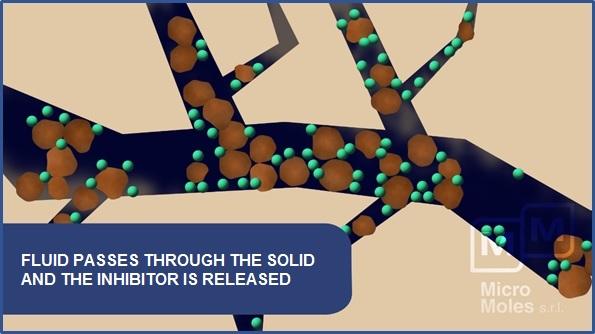
As production fluid passes through the solid, the inhibitor is released. That is, to the extent that the production fluid contacts the solid inhibitor, the chemical in charge of the inhibition flows inhibiting the formation against paraffins, scale incrustations, corrosion, bacteria, etc. Therefore, the production of the well determines the amount of inhibitor released. Only a small amount of inhibitor is necessary for inhibition. No contact time is needed to achieve this inhibition; the well flow rate determines the amount of chemical released.
The
versatility of the microencapsulation technique also allows the selection and
development of new solid carriers, with structural and functional
characteristics that can be adjusted to the specific requirements of each
client. The solid matrices are selected through a process of evaluating the size
and particle structure required for each application and the absorption-desorption
capacity required. An example of this is the selection of carriers with
specific size and permeability that can enter and dispose adequately and
release the active agent in a controlled manner in a rock formation during the
oil and gas production activity.
The encapsulation process allows obtaining
encapsulated materials with the maximum liquid active principle possible to be
absorbed, achieving up to 70% of microencapsulation of the Active in the
Carrier matrix, maintaining the dry and fluid aspect of the original solid. The
development of new carriers can even increase this percentage.
WAYS OF APPLICATION
There
are many methods of applying these solids, the most common being:
A) Production:
One of the areas of application of solid inhibitors are production wells that
have historically had productivity problems. Since these wells were completed
without any solid inhibitor application, many production companies seek to solve
these problems with this technology. The application is made through a coiled
tubing that places the solid inhibitor in the rathole (downhole), from where
the product will act, releasing the active principle as the production fluid
contacts the solid inhibitor. It is the well flow rate that determines the
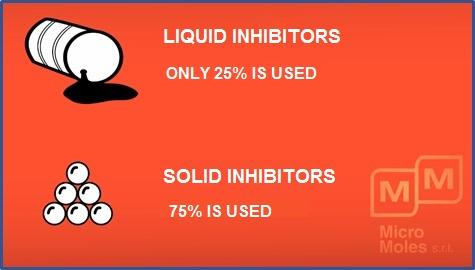
amount of chemical released. With this technology it is possible to apply
significantly less amount of solid chemicals in comparison with the use of
homologous liquids, due to the focused action and gradual release into the well.
B) Fracking:
It is the most appropriate time to apply the treatment, since the inhibition
begins from the moment the well is put into production. It is the most
effective treatment over time. The solid microspheres are designed to be mixed
with the support agent (proppant). The selection in size and shape allows the
solids to be applied together with the proppant agent, and they are easily
incorporated in the fracture work, where it can be dosed in the mixer.
Microencapsulated products offer several advantages in the oil&gas sector:
• ·
Instant action of the solid when it comes
into contact with the liquid system, and the addition of long-term residual
action, without having to replenish the product as in the case of liquid
products.
·
Controlled release, by which the chemical
released is the one required by to treat the problem, reducing product loss and
ensuring there is no chemical waste in the environment. The quantities used are
significantly lower than in the case of the same liquid products.
·
The possibility of mixing several solid
inhibitors to attack several problems (scale, corrosion, paraffins, H2S,
bacteria) in a single application, achieving the combined action of several
active chemicals in a single dosage, reducing the amount of added material, and
avoiding the addition of n amount of liquid
counterparts. This mixture cannot be made in the current liquid products,
since, when mixing concentrated liquid active agents, these can interact and
degrade each other when housed in a single liquid matrix, while this process
does not occur and is avoided when lodging them in individual microencapsulated
solid matrices, where they have almost no mobility.
·
Uniform and long-lasting inhibition.
·
Encapsulation minimizes adsorption of the
inhibitor in the formation.
·
Solid encapsulated products allow their
use in fracturing applications (mixed with proppant support agent), and can also
be used for long-term production protection (rathole dosing).
·
The possibility of varying the particle
size of the carrier according to each application and specific requirement.
·
Solid products easy to handle and store.
Easy to clean, there is no liquid spill.
·
Environmental: Spills do not pollute and
are easily cleaned. Because of the controlled release, the quantities used are
significantly lower than in the case of similar liquid products. This means
that the amount of chemical sent to the formation (earth) of the oil&gas
wells is much lower than in the case of liquids. Many of the materials used as
carriers are food-grade so they do not pollute. While the liquids carrier is
normally a polluting solvent.
·
For the worker: There is no risk of skin,
eyes or nose being exposed to dangerous liquids. Lower quantities of product,
less physical effort. Reduced emissions and vapors.
Lower comparative cost in respect of liquid inhibitors, because their performance with respect to the dose (PPM) used is superior to conventional liquid chemicals. And lower transportation costs.
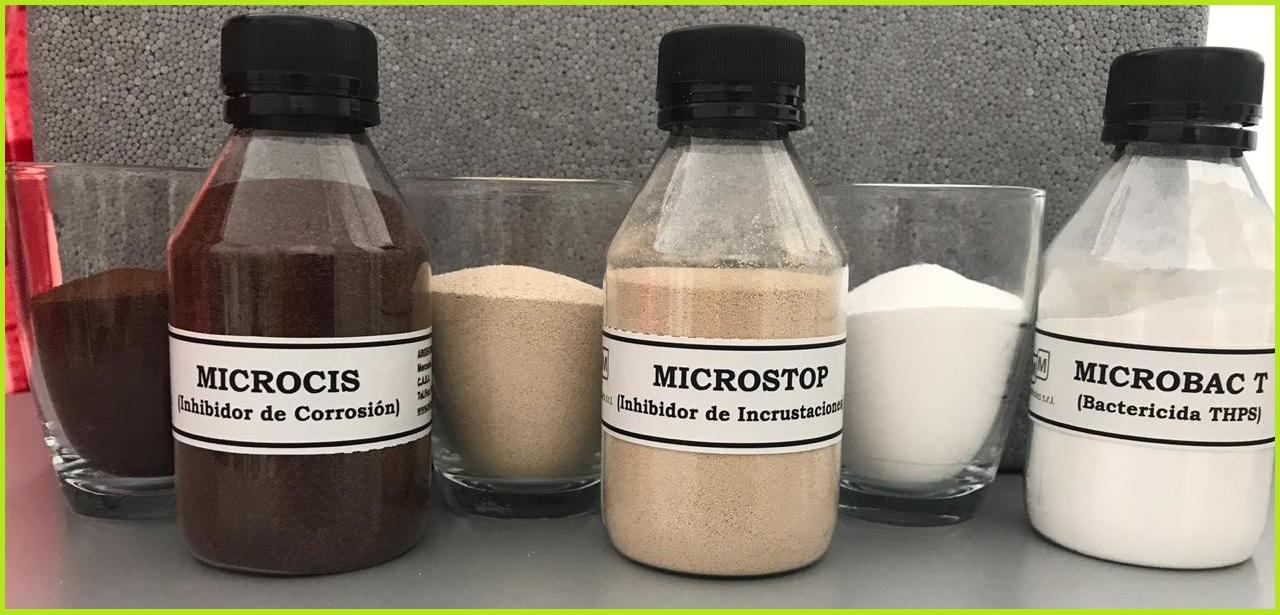
Check available Products.
Request technical-commercial advice, and availability of TDS y FDS sheets.
-
 A convenir : Te contactaremos al teléfono que indicaste para coordinar el envío o entrega
-
 A convenir :